Types of Cybersecurity Controls: Preventive, Detective, and Corrective Explained

Originally Published: Dec. 12, 2024
Last Updated: June 27, 2026
By Tracey Birkenhauer, journalist and Chief Impact Officer, STACK Cybersecurity
What's stopping cybercriminals from turning your business into their next target?
Executive Summary
Cybersecurity controls are the measures, both administrative, technical, and physical, that protect a business's data and systems from attack. Outsourcing IT and security to a managed security services provider (MSSP) does not remove a company's own responsibility to maintain internal policies, vendor oversight, and access controls. This post breaks down the three categories of controls, explains how STACK Cybersecurity layers preventive, detective, and corrective measures to build a full defense, and answers the questions business owners ask most often when evaluating their own security posture.
Reported cybercrime losses in the United States hit $20.877 billion in 2025, a 26% jump from the year before, according to the FBI's 2025 Internet Crime Report. The FBI's Internet Crime Complaint Center logged more than 1 million complaints last year, up from about 859,500 in 2024.
Verizon's 2025 Data Breach Investigations Report found that stolen credentials remained a leading way in for attackers, present in 22% of confirmed breaches, while exploited vulnerabilities accounted for another 20%. Third-party involvement in breaches doubled year over year to 30%. On the cost side, IBM's 2025 Cost of a Data Breach Report found the global average cost of a breach fell to $4.44 million, down 9% from $4.88 million in 2024, largely because businesses using security automation and AI-assisted detection contained incidents faster.
Introducing the MSSP
Cybersecurity covers a wide range of areas, including server security, network security, mobile device security, data security, and electronic systems security. Most MSSPs will even service your camera system because it's essential for overall security.
Without strong internal cybersecurity controls, you're left vulnerable. In this post, we'll cover why cybersecurity controls matter and the different types available to protect your sensitive data and support long-term resilience.
What Are Cybersecurity Controls?
Cybersecurity controls are measures and mechanisms designed to protect information systems and data from cyber threats. These controls help detect, prevent, and mitigate security risks while protecting critical assets' confidentiality, integrity, and availability. They serve as the building blocks of a strong cybersecurity strategy, providing layers of defense against internal and external threats.
Why Must Your Business Consider Cybersecurity Controls?
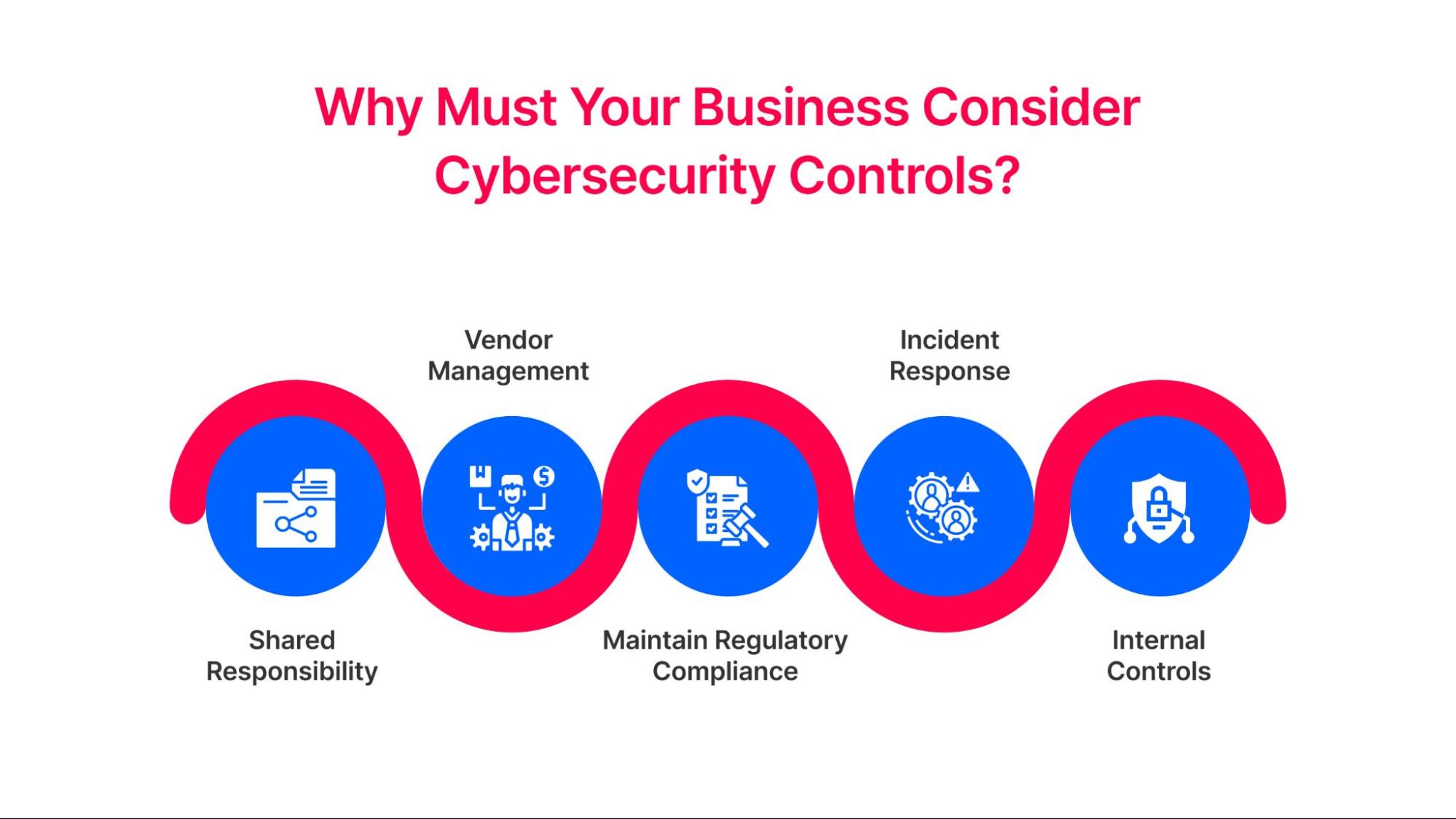
Looking to minimize your cyber risks? Implementing strong cybersecurity controls prevents threats, limits potential damage, and supports sustainable growth.
Even if you outsource IT and cybersecurity, you must implement cybersecurity controls. Here's why:
Shared Responsibility
Outsourcing doesn't eliminate your responsibility for data security. You must publish and enforce internal policies and procedures to protect your data, such as Acceptable Use and Bring Your Own Device. You also must ensure your MSSP follows strong security practices and complies with relevant regulations. Business leaders who assume a vendor contract alone covers this exposure often overestimate how protected they actually are, a pattern we cover in our post on cybersecurity overconfidence.
Vendor Management
Effective vendor management includes assessing the security measures of your outsourced cybersecurity provider. This involves confirming the provider has adequate tools and talent to protect your environment. Some low-cost MSSPs use off-shore technicians, and many rely on free, open-source applications that are often compromised. Not all MSSP stacks are equal. Most of them fall short.
Maintain Regulatory Compliance
Many industries have specific regulatory requirements for data protection. You must ensure that your internal practices and your outsourced IT provider meet these standards. Note STACK Cybersecurity is SOC 2 Type 2 certified, meeting the highest cybersecurity standards.
Incident Response
Having an incident response plan is crucial. You should coordinate with your MSSP to ensure quick and effective responses to security incidents, and our own Incident Response Best Practices guide walks through what that plan should include.
Features like real-time threat detection, data recovery systems, and incident response plans limit downtime and speed recovery. For businesses that depend on uninterrupted service delivery, these measures are essential to avoid cascading losses and keep customers satisfied.
Internal Controls
You should maintain internal controls to protect sensitive information and ensure only authorized staff can access critical systems and data.
Advanced Controls for Modern Cybersecurity
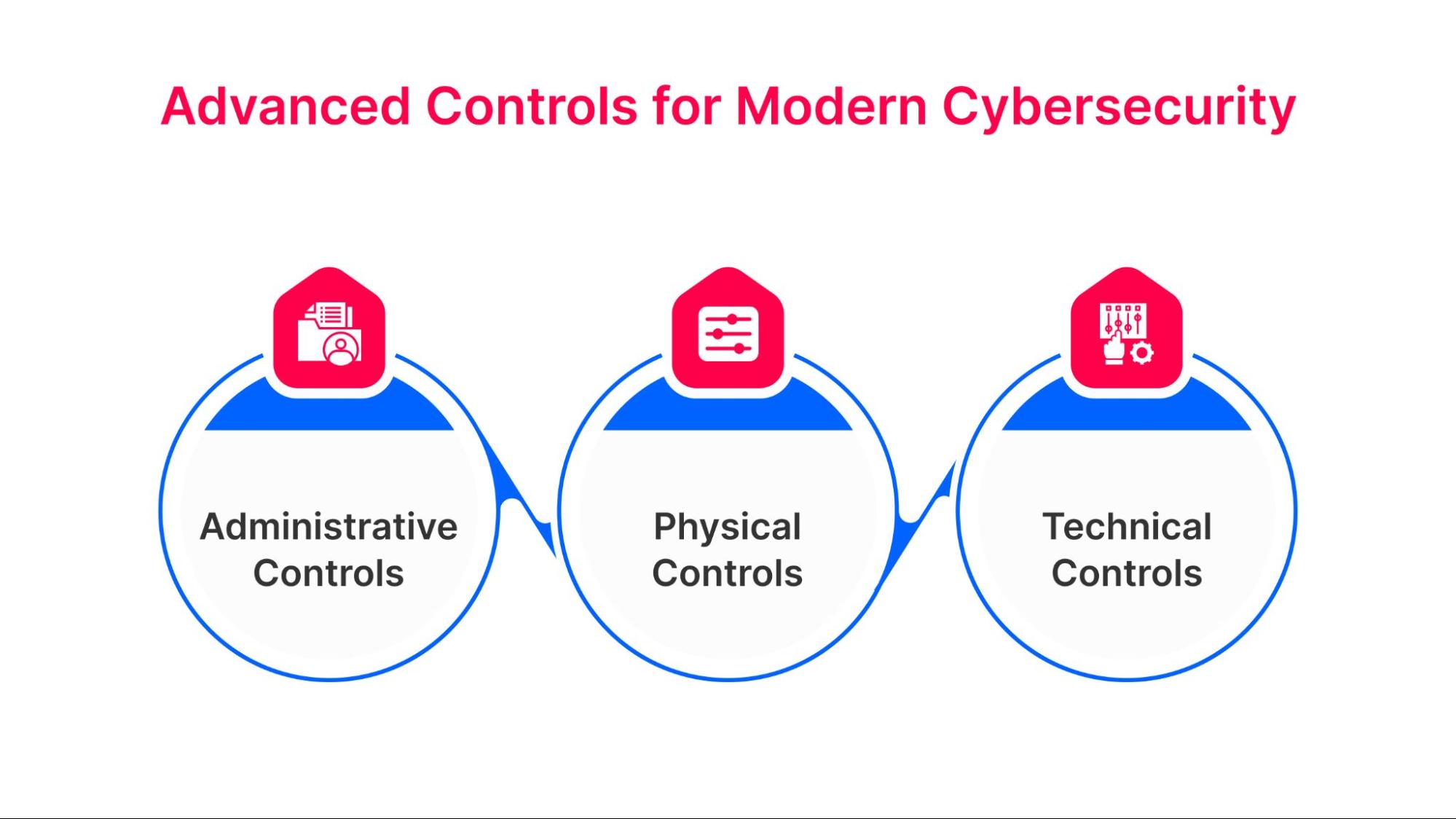
As cyber threats grow more sophisticated, it's crucial to implement advanced cybersecurity measures that address vulnerabilities holistically. By combining administrative, technical, and physical controls, we help you build a well-rounded security posture that keeps your systems and data safe.
Administrative Controls
Administrative controls are the foundation of a strong security strategy. They include policies, procedures, and guidelines that build a security-first culture across your business. These controls guide how risks are assessed, mitigated, and managed while keeping everyone accountable for protecting sensitive information.
Here are some ways administrative controls can strengthen your defenses.
Security Awareness Training. We help educate your team on recognizing phishing attempts, creating strong passwords, and following security protocols. Regular training meaningfully cuts the risk of human error, still one of the leading causes of breaches.
Access Control Policies. We define who has access to critical systems and data, with privileges assigned based on roles and responsibilities.
Incident Response Documentation. Clear, actionable guidelines ensure your team knows exactly what to do when responding to security incidents, limiting damage and downtime. The Cybersecurity and Infrastructure Security Agency (CISA) publishes free incident response playbooks businesses can use as a starting point.
By embedding cybersecurity into daily operations, you create a team that's proactive about security. With the right training and policies, everyone contributes to defending against threats like phishing and social engineering.
Technical Controls
Technical controls use software and hardware solutions to protect your digital assets from modern threats. These controls rely on newer technologies to detect, prevent, and respond to attacks in real time, and increasingly reflect zero trust principles that assume no user or device should be trusted by default.
For example, AI-powered threat detection systems analyze patterns and anomalies across your network, identifying potential attacks before they cause harm. By automating many security tasks, these tools free up your team to focus on what matters most.
Here's how we implement technical controls.
Encryption Standards. Protect sensitive data by converting it into unreadable formats for unauthorized users, keeping your information secure during transmission and storage.
Network Segmentation. Divide your network into smaller, isolated segments to limit the spread of threats, making it easier to monitor and manage.
Secure Configurations. We help configure your systems for maximum security, closing weak spots attackers could exploit.
Threat Hunting. Our advanced tools and analytics proactively search for potential risks in your environment, identifying and neutralizing them before they escalate.
These solutions evolve alongside the threat landscape, keeping your systems ahead of attackers.
Physical Controls
Physical controls protect your hardware, facilities, and tangible assets from unauthorized access and environmental risks. While often overlooked, they're critical to a full cybersecurity strategy.
You can secure your physical spaces with measures like the following.
Surveillance Systems. Keep an eye on your facilities with monitoring tools that deter unauthorized access and provide evidence if needed.
Biometric Access Control. Ensure only authorized personnel can access critical areas using fingerprint scans, facial recognition, or other unique identifiers.
Secure Facility Design. Protect your infrastructure with reinforced doors, fire suppression systems, and controlled access zones.
In an era where digital and physical threats often overlap, physical controls complement technical measures. For example, biometric systems allow only authorized individuals to access server rooms, cutting the risk of insider threats and hardware tampering.
How Does STACK Cyber Implement Cybersecurity Controls?
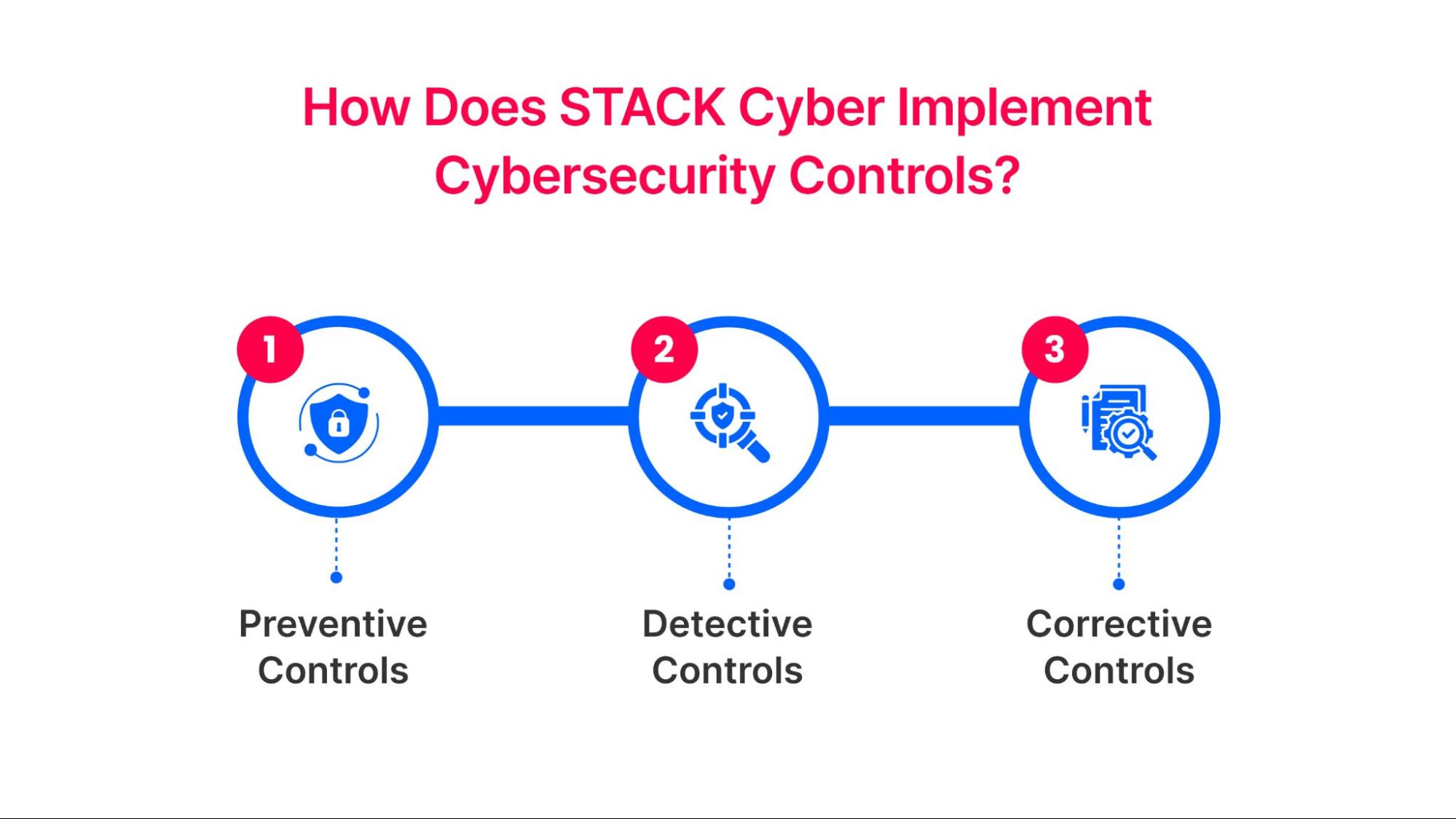
At STACK Cyber, we take a structured approach to cybersecurity by implementing preventive, detective, and corrective controls that work together to protect your business from sophisticated threats. Here's how we approach each aspect.
Preventive Controls
Our preventive controls act as the first layer of protection and stop cyber threats before they affect your operations. Here is how we focus on implementing these critical measures.
Managed Security Operations Center (SOC). We offer a SOC that provides 24/7 monitoring, detection, and response to cyber threats. This service reduces the cost and complexity of building and maintaining your own SOC, letting you focus on your core business.
Password Management. Weak or reused passwords are a common vulnerability, making businesses easy targets for attackers. Our password manager generates strong, unique passwords for every account that follows the National Institute of Standards and Technology's SP 800-63-4 digital identity guidelines, securely stores them using encryption, and simplifies access across devices.
Dark Web Monitoring. We actively monitor breaches and leaks on the dark web to identify if your credentials have been compromised. Early detection lets us act swiftly, cutting the risk of unauthorized access.
Firewalls. We implement firewalls that monitor and control incoming and outgoing network traffic based on predefined security rules. They help block unauthorized access and malicious traffic, keeping your network secure.
Multi-Factor Authentication (MFA). With MFA, we add an extra layer of security by requiring users to verify their identity through multiple methods, such as a password and a one-time code. Verizon's 2025 DBIR still found stolen credentials behind 22% of breaches, which is exactly the failure mode MFA is designed to close, even as attackers look for ways around it.
Secure Software Development Practices. For businesses developing custom applications, we integrate security at every stage of the software development lifecycle. This includes code reviews, static analysis, and penetration testing to identify and fix vulnerabilities before they can be exploited.
eXtended Managed Detection and Response (MXDR). Our MXDR service pairs technology with human expertise to deliver real-time monitoring, swift detection, and rapid response. By continuously analyzing network activity, system logs, and security events, MXDR supports proactive threat management, helping you stay ahead of potential risks and maintain a strong security posture.
Endpoint Protection Systems. Your devices are a common target for cyberattacks. We implement endpoint protection solutions that safeguard computers, smartphones, and other devices from malware, ransomware, and other threats. These systems often include antivirus software, data encryption, and device control.
By deploying these preventive controls, we help you build a solid foundation for cybersecurity, reducing vulnerabilities and the likelihood of attacks.
Detective Controls
Preventive measures are not enough. Detecting threats that bypass initial defenses is essential. Our detective controls identify and alert you to potential security incidents in real time.
Intrusion Detection Systems (IDS). Our IDS solutions monitor network traffic for suspicious activity or attack signatures. If a threat is detected, we respond immediately to contain and address the issue.
Security Information and Event Management (SIEM). Our SIEM service provides a centralized view of your security landscape, enabling proactive threat identification. We aggregate and analyze data from across your systems, including logs, alerts, and user activity, to identify patterns that could indicate a threat.
Anomaly Detection Tools. We use machine learning and behavioral analytics to spot deviations from regular activity. These anomalies can indicate a breach, allowing us to address issues before they escalate.
Our detective controls give us the visibility needed to catch and address threats early, limiting their impact on your business.
Corrective Controls
Corrective controls are critical to limiting damage and restoring normal operations when an incident occurs. We help your business prepare to recover as quickly and effectively as possible.
Data Recovery Systems. We set up reliable backup and restore mechanisms, so if ransomware strikes or data is accidentally deleted, you can recover your critical information quickly and with minimal downtime.
Incident Response Plans. A clear, predefined response plan ensures your team knows exactly what to do when a breach happens. We work with you to develop and refine these plans, drawing on the same framework covered in our Incident Response Best Practices guide, so your response stays timely and effective.
Patching Vulnerabilities. After an incident, closing any security gaps that may have been exploited is crucial. We help you identify and patch these vulnerabilities, cutting the risk of a similar event happening again.
Our corrective controls help you respond to incidents with confidence, allowing your business to recover and move forward with minimal impact.
With these cybersecurity controls, we help businesses build a strong, multi-layered cybersecurity strategy that protects assets and supports long-term operational resilience.
Deploy Effective Controls with STACK Cybersecurity
Securing your business requires more than basic protective measures. It demands a full approach to managing risks and strengthening your defenses. By combining help desk support with strong cybersecurity controls, STACK helps clients' IT systems stay secure and operational.
For instance, our Managed eXtended Detection and Response (MXDR) solution recently identified unusual login patterns at a client site, letting us intervene before data could be compromised.
For our manufacturing clients, implementing preventive controls like endpoint protection supports compliance with CMMC certification standards while protecting intellectual property critical to defense contracts.
So far this year, we have prevented thousands of attempted breaches using Security Information and Event Management (SIEM) backed by a 24/7 Security Operations Center (SOC). Our clients appreciate that our Customer Satisfaction Score (CSAT) is a perfect 100%, as is our Facebook rating.
Take charge of your company's security.
Schedule a Consultation
Frequently Asked Questions (FAQs)
What are the three main types of cybersecurity controls?
Cybersecurity controls fall into three categories: administrative controls, which are the policies and training that build a security-first culture; technical controls, which are the software and hardware tools that detect and block threats; and physical controls, which protect facilities, hardware, and other tangible assets from unauthorized access.
If I outsource my IT to an MSSP, do I still need internal cybersecurity controls?
Yes. An MSSP handles the technical heavy lifting, but your business still owns internal policies like Acceptable Use and Bring Your Own Device, vendor oversight, and regulatory compliance. Security is a shared responsibility between your company and your provider.
What is the difference between preventive, detective, and corrective controls?
Preventive controls, like firewalls and MFA, stop threats before they reach your systems. Detective controls, like SIEM and intrusion detection, identify threats that get past prevention. Corrective controls, like backups and incident response plans, help your business recover after an incident occurs.
How often should a business review its cybersecurity controls?
Most businesses should review their controls at least once a year, and again after any major change, such as a new software rollout, a merger, or a shift to remote work. Regulated industries, including manufacturers pursuing CMMC certification, often face more frequent review requirements.
Does multi-factor authentication actually stop most attacks?
MFA closes off one of the most common ways attackers get in, which is a stolen or guessed password. It's not foolproof on its own, but paired with Dark Web monitoring, endpoint protection, and employee training, it meaningfully lowers the odds a compromised credential turns into a full breach.
 Gaps in your corporate security posture? Contact us for a cybersecurity assessment.