What Is SIEM?
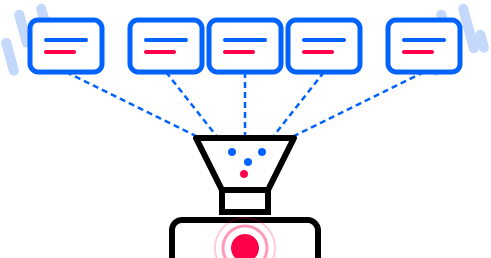
Security Information and Event Management (SIEM) collects and analyzes log data from across your IT environment, including endpoints, firewalls, servers, cloud platforms, and applications, and correlates it into a single, searchable record of security activity.
On its own, every device and application in your environment generates logs. Separately, those logs are noise. A managed SIEM centralizes them, applies detection rules and analytics, and surfaces the events that actually warrant attention, giving your security team and ours the visibility to detect threats, investigate incidents, and demonstrate compliance.
Why Managed vs. Self-Managed?
A SIEM platform is only as useful as the team tuning and monitoring it. Out-of-the-box detection rules generate significant noise. Without ongoing tuning, alert fatigue sets in quickly and real threats get buried. Most businesses don't have the in-house expertise to maintain a SIEM effectively.
With managed SIEM from STACK, you get the platform, the configuration, the ongoing tuning, and the analyst oversight, without hiring and maintaining a dedicated security operations team. We handle the signal-to-noise problem so your team sees only what needs action.
 Need reliable IT support for your business? Contact us to learn how STACK Cybersecurity can support your IT and cybersecurity.
What Managed SIEM Covers
SIEM works by aggregating log data from every layer of your environment, correlating events across sources, and applying detection logic to identify patterns that indicate a threat, policy violation, or compliance gap. STACK manages the full lifecycle.

Log Collection
Security event data is ingested from endpoints, firewalls, servers, cloud platforms, identity systems, and applications into a centralized platform.

Threat Detection
Correlation rules and behavioral analytics identify suspicious patterns across log sources, surfacing credible threats rather than raw alerts.

Compliance Reporting
Audit-ready reports are generated from retained log data, supporting compliance with CMMC, HIPAA, PCI DSS, and other frameworks that require documented security monitoring.

Incident Investigation
When an incident occurs, retained logs provide the historical record needed to determine scope, timeline, and how an attacker moved through your environment.

Ongoing Tuning
Detection rules and alert thresholds are continuously refined to reduce false positives and improve signal quality as your environment evolves.

Real-Time Alerting
Validated alerts are routed to your security team and STACK analysts immediately, with context and recommended response steps included.
Log Retention and Compliance
How long you retain logs matters as much as whether you collect them. Many compliance frameworks specify minimum retention windows, and cyber insurers increasingly require at least one year of log history as a condition of coverage. If an incident is discovered after your logs have already been purged, the forensic evidence needed to understand scope and impact is simply gone.
Retention requirements vary by framework. PCI DSS requires one year of log retention with the most recent 90 days immediately accessible. HIPAA mandates six years for covered healthcare entities. CMMC and NIST 800-171 require continuous audit evidence without specifying a fixed window. STACK's three retention tiers let you match your retention posture to your actual compliance obligations rather than paying for more than you need.
Retention Tiers
STACK offers three log retention tiers to match different compliance requirements, risk profiles, and budgets. All tiers include the same core SIEM capabilities: centralized log collection, real-time detection, alerting, and analyst oversight. The difference is how far back your searchable log history extends.
Need longer retention for HIPAA, SOX, or a cyber insurance requirement? STACK can discuss extended retention options beyond 90 days. Talk with a specialist about what your specific framework requires.
SIEM and MXDR Together
SIEM and MXDR are complementary. SIEM centralizes and retains your log data, providing the historical record and compliance documentation layer. MXDR extends detection and active response across your entire attack surface in real time. Together, they give you both the depth of log history and the breadth of coverage that a mature security program requires.
STACK's Managed Service Advanced tier includes MXDR as part of a fully integrated security engagement. SIEM can be added as a retention and compliance layer on top, giving your security operations team a complete picture from a single provider.
Learn About MXDR
Not Sure Which Tier You Need?
Your retention requirement depends on what compliance frameworks apply to your business, your cyber insurance policy, and how quickly your team can realistically detect and investigate an incident. STACK can walk you through the options and help you choose a tier that fits your obligations without overbuilding.
A Security Risk Assessment is a good starting point if you're not yet sure where your logging and compliance gaps are.