What Is a Tabletop Exercise?
A tabletop incident response exercise is a structured, discussion-based simulation that walks your team through a realistic cyberattack scenario. Key stakeholders from IT, security, legal, communications, and leadership come together to work through how they'd respond: what decisions get made, who owns which actions, how communication flows, and where the current plan breaks down.
It's the difference between having an incident response plan and knowing whether it actually works. Plans that look complete on paper often unravel the first time a team tries to execute them under pressure. A tabletop exercise surfaces those gaps in a controlled environment, before a real attack does.
Why It Matters
When a real incident occurs, the decisions your team makes in the first hours determine whether the situation is contained or catastrophic. Roles that seemed clear in a document become ambiguous. Communication chains break down. Recovery steps assumed to be straightforward turn out to have dependencies nobody mapped. The time to discover this is not during a live ransomware event.
Regular tabletop exercises build the muscle memory your team needs to respond with confidence. They also satisfy compliance requirements: CMMC, cyber insurance carriers, and frameworks including NIST and ISO 27001 increasingly require documented evidence that incident response plans have been tested.
 Need reliable IT support for your business? Contact us to learn how STACK Cybersecurity can support your IT and cybersecurity.
What the Exercise Covers
STACK facilitates a structured exercise built around a scenario tailored to your business, industry, and actual risk profile. The goal isn't to trick your team. It's to surface where your plan is strong and where it needs work.
Scenario Development
We design a realistic attack scenario relevant to your environment, such as ransomware, business email compromise, data exfiltration, or a vendor compromise, drawing on current threat intelligence.
Facilitated Session
A STACK facilitator guides your team through the scenario, introducing new developments and decision points that reflect how real incidents actually unfold rather than following a clean, linear script.
Gap Identification
Discussion reveals where roles are unclear, communication chains break down, recovery dependencies are unmapped, or response steps assumed to be straightforward are actually missing.
After-Action Report
Following the session, STACK produces a written after-action report documenting findings, gaps identified, and prioritized recommendations for improving your incident response plan.
Realistic, Relevant Scenarios
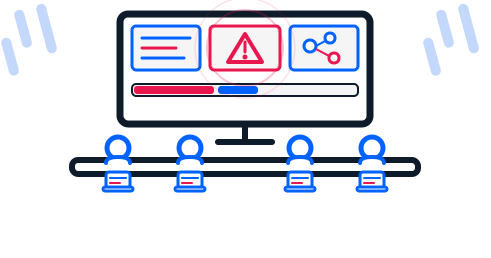
The scenario drives everything. A generic exercise produces generic insights. STACK builds scenarios around the threats most relevant to your industry and environment, then introduces realistic complications as the session progresses: a key responder is unreachable, a vendor is involved, regulators are asking questions, or the press has gotten hold of the story.
Common scenario types include ransomware with data exfiltration, business email compromise involving a fraudulent wire transfer, a compromised vendor or supply chain incident, a data breach affecting customer records, and insider threat scenarios. The right choice depends on where your actual risk is highest.
Who Should Be in the Room
Incident response is not just an IT problem. A well-run tabletop exercise brings together every stakeholder who would have a role in a real incident. Technical responders handle containment and recovery. Leadership makes decisions about business continuity and risk tolerance. Legal and HR manage regulatory obligations and personnel issues. Communications handles internal and external messaging.
Exercises that only involve the IT team reveal technical gaps. Exercises that include the full cross-functional team reveal the coordination and communication gaps that are just as likely to determine the outcome of a real incident.
Compliance and Insurance Value
Auditors and regulators routinely ask for evidence that incident response plans have been tested. A documented tabletop exercise with an after-action report satisfies that requirement for CMMC, NIST CSF, ISO 27001, and SOC 2 audits. Cyber insurance carriers are increasingly requiring proof of regular IR exercises as a condition of coverage or favorable rates.
The after-action report STACK produces maps findings to your applicable frameworks and provides the documentation trail your auditors and insurer will look for.
Ready to Test Your Response Plan?
If your incident response plan has never been tested against a realistic scenario, you don't know whether it works. STACK can design and facilitate a tabletop exercise tailored to your business, and help you act on the findings.