Cybersecurity Data Disrupted by Google AI Overviews

Originally Published: Aug. 3, 2026
By Tracey Birkenhauer, journalist and Chief Impact Officer, STACK Cybersecurity
Google's AI Overviews are changing how users interact with search results. Instead of reviewing multiple websites to answer a question, users are increasingly presented with AI-generated summaries directly on the search engine results page (SERP).
Studies analyzing AIOs, such as economic and technical research on search mechanics, reveal fundamental shifts in how information is indexed, summarized, and consumed online. For the cybersecurity sector, these changes directly impact threat intelligence dissemination, vendor visibility, and how security teams or researchers share critical technical content.
Executive Summary
A June 2026 field experiment conducted by researchers from Carnegie Mellon University and the Indian School of Business found the addition of a Google AI Overview (AIO) on a results page reduced outbound clicks to websites by 39.8%.
The field experiment also found a 34.5% increase in zero-click searches, meaning users were more likely to get their answer directly from the search engine results page than leaving to visit another website.
Similar studies have found similar results, with some finding even more significant changes in user behavior.
Researchers found no measurable improvement in user satisfaction, perceived quality of information, or usability. The results raise questions about how businesses, publishers, and cybersecurity professionals should approach Google's AI overviews.
While AI can accelerate research and provide quick answers, companies still require processes that encourage source verification, critical thinking, and the use of authoritative references for cybersecurity, compliance, legal, and business decisions.
Cybersecurity Impact
Security blogs, vulnerability write-ups, and advisory notices rely heavily on web traffic to alert IT professionals. If security practitioners get summarized remediation steps directly inside an AIO without visiting the underlying expert blog or threat feed, independent creators and boutique advisory firms lose essential visibility and revenue. This disincentivizes deep, original technical publishing.
Generative search features rely on pattern recognition to stitch together summaries from multiple sources, which introduces risks of synthesis errors or miscontextualizing data.
And AI results have proven unreliable, as these tools hallucinate, providing inaccurate information authoritatively. These hallucinations have even led to court battles. Companies have suffered losses after chatbots have falsely reported they engaged in illegal actions. Even after retraining the tools not to say these things, the chatbots continued dispersing inaccurate information.
In cybersecurity, precision is everything. If an AIO incorrectly aggregates code snippets, misstates compliance framework controls (such as blending CMMC or NIST requirements), or mixes up specific patch versions for a critical vulnerability, it introduces a dangerous operational risk. Security teams scanning search results for quick answers could ingest flawed remediation protocols or faulty indicators of compromise (IoCs).
AIO trigger rates for cybersecurity keywords have increased about 3–5 percentage points per quarter since Google's full rollout. Keywords that didn't trigger AIOs six months ago may trigger them today, according to Webmunk: A New Tool for Studying Online Behavior and Digital Platforms, a working paper developed by the National Bureau of Economic Research. The image below highlights study findings.
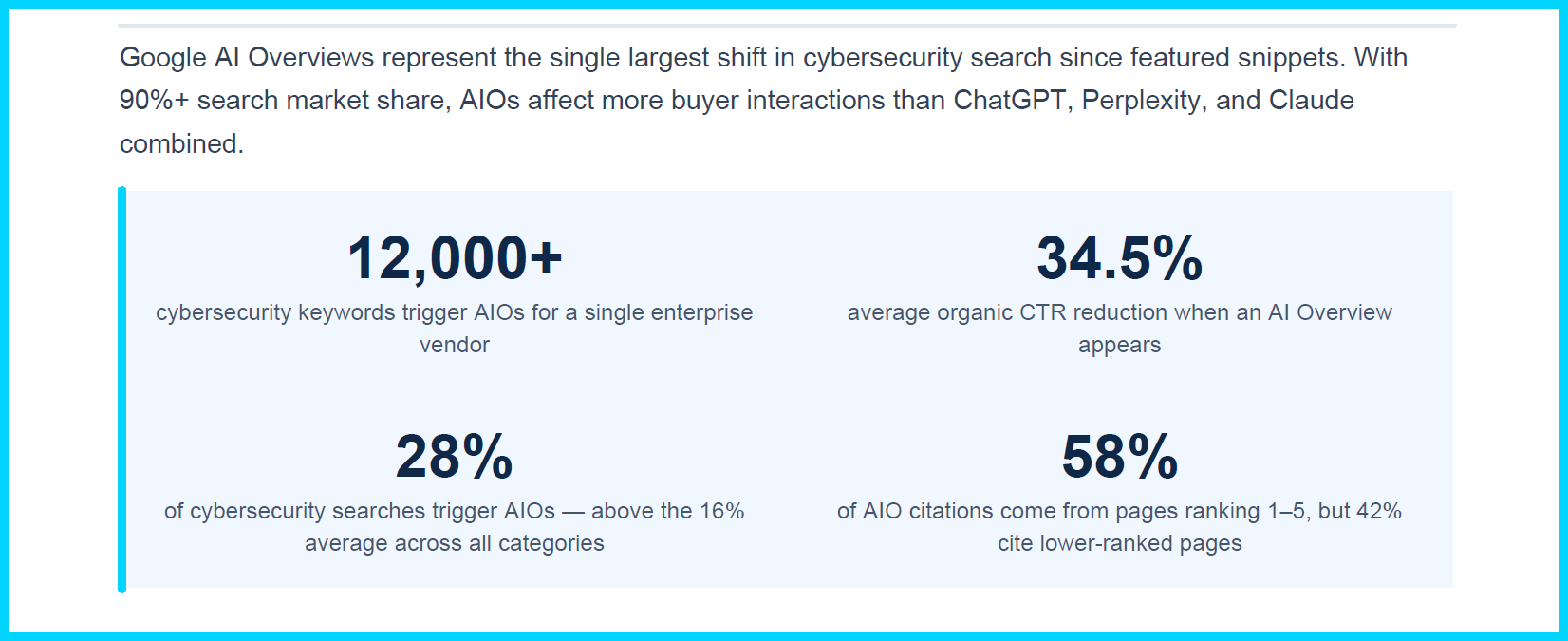
The Webmunk study analyzed more than 15,000 cybersecurity-related keywords, revealing AIOs appear for about 28% of cybersecurity searches overall, much higher than the 16% average for all search categories.
"Cybersecurity's higher trigger rate reflects the query complexity and informational depth of security-related searches, which align with AIO's strengths in synthesizing multi-source information," according to the study.
A Perspective From STACK Cybersecurity
"Artificial intelligence can help companies gather information faster, but cybersecurity decisions still require context, verification, and human judgment. Whether a recommendation comes from a search engine, a chatbot, or a vendor, you need to understand where the information originated before acting on it."
Rich Miller, CEO, STACK Cybersecurity
Search Results No Longer List of Links
Search engines have historically operated primarily as discovery tools. A user entered a question, evaluated search results, and selected sources to review. Publishers, researchers, journalists, vendors, and industry experts created content. Search engines helped users find it.
Google launched AI Overviews (AIOs) in May 2024 for select queries. These snippets synthesize search results into direct answers on the search results page.
AI-generated search experiences introduce another layer between the user and the source material. Instead of directing users to multiple websites, generative AI systems can summarize information into a single response displayed directly within the search results.
The result is a different browsing experience. Users may receive an answer more quickly, but they may also spend less time reviewing the underlying sources from which that information originated.
What Research Uncovered
For the AIO field experiment, researchers recruited more than 1,000 participants and analyzed over 68,000 searches using a custom Chrome extension that allowed them to compare standard Google Search results with a version of Google Search where AIOs were removed and another where AIOs appeared for every search.
AIOs appeared in about 41% of searches observed during the study. The effect was strongest for informational versus transactional searches. The position of AI summaries was also vital.
"Overall, the results suggest that AIOs divert traffic away from publishers without improving the user experience or quality of engagement for websites," according to the study findings.
Why Cybersecurity Teams Should Care
Many cybersecurity decisions depend on accuracy, context, and source validation. Security teams routinely evaluate vendor advisories, Cybersecurity and Infrastructure Security Agency (CISA) guidance, National Institute of Standards and Technology (NIST) publications, cyber insurance requirements, compliance frameworks, and threat intelligence reports.
Those resources often contain critical details that affect implementation decisions. Product versions, mitigation instructions, regulatory exceptions, configuration guidance, timelines, and environmental differences can influence whether a recommended action applies to a particular business.
A summarized response may be useful as a starting point, but security professionals still need access to original sources when making decisions related to incident response, compliance, vulnerability management, cloud security, or risk management.
"For cybersecurity marketers, AIOs represent both a threat and an opportunity," according to the Webmunk study. "They reduce clicks to organic listings (threat), but they also provide a prominent citation position that reaches every Google searcher for that query (opportunity). Being cited in an AIO is arguably more valuable than ranking #1 organically, the AIO occupies the entire above-the-fold viewport and captures the majority of searcher attention."
Good Decisions Rely on Good Information
The 2026 Google AI Overview study highlights a significant shift in how information is consumed online. Researchers found fewer website visits when AI-generated summaries appeared, yet they found no measurable improvement in the user experience.
For cybersecurity professionals, the findings reinforce a familiar lesson. Good decisions depend on good information. Understanding where information came from, whether it is current, and whether it applies to a specific situation remains an essential part of risk management.
Artificial intelligence can help users find answers. Companies still need employees who know how to evaluate them.
AI Readiness Survey
Free Assessment
Evaluate Your Corporate AI Readiness
Understand where your business stands on its AI readiness journey with this structured assessment covering governance, security, compliance, and implementation planning.
Frequently Asked Questions (FAQs)
What are Google AI Overviews?
Google AI Overviews are AI-generated summaries that appear directly within search results. They combine information from multiple sources and present an answer before traditional website listings.
How much traffic do AI Overviews reduce?
A June 2026 field experiment found that AI Overviews reduced outbound website clicks by 39.8% when they appeared in search results and increased zero-click searches by 34.5%.
What is a zero-click search?
A zero-click search occurs when a user receives the information they need directly from the search results page and leaves without visiting another website.
Why does this matter to cybersecurity professionals?
Cybersecurity teams frequently rely on authoritative sources such as CISA advisories, NIST guidance, vendor security bulletins, and threat intelligence reports. Important details may exist in the original source material that are not included in summarized content.
Can AI-generated search results be inaccurate?
Yes. Generative AI systems can produce inaccurate or fabricated information, commonly called hallucinations. Important business, legal, compliance, and cybersecurity decisions should be validated against trusted sources.
What cybersecurity risks are associated with AI systems?
Government and industry guidance identifies risks including prompt injection, data leakage, sensitive information disclosure, shadow AI, model poisoning, insecure integrations, and excessive reliance on AI-generated outputs.
Should employees rely on AI-generated answers for cybersecurity decisions?
AI-generated responses can be useful for research and preliminary information gathering. Security, compliance, legal, and operational decisions should be validated using authoritative documentation and subject matter expertise.
Will AI search eliminate the need for websites and original content?
AI systems still rely on content created by publishers, researchers, experts, vendors, and industry organizations. Original research, technical documentation, regulatory guidance, and expert analysis remain essential sources of information.